Project Mars: The Blueprint for Humanity's Second Home
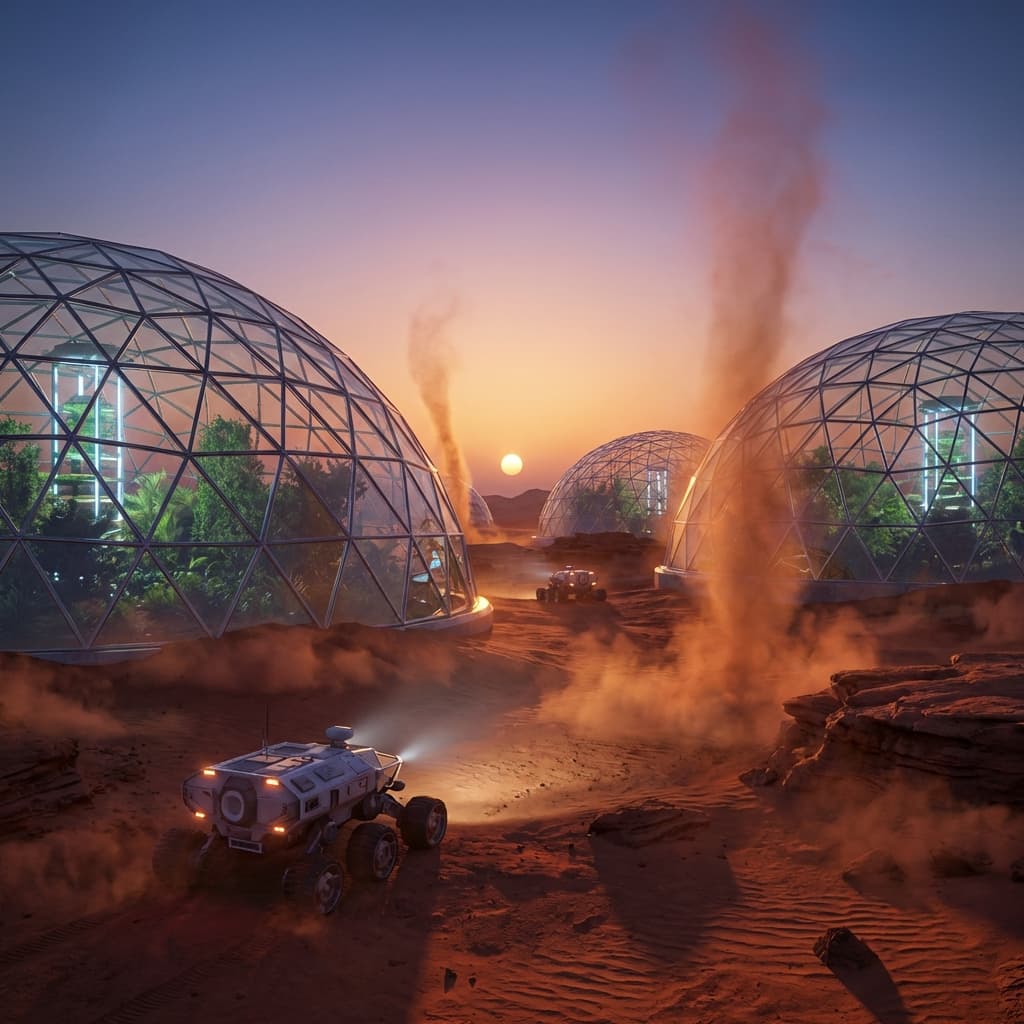
For thousands of years, Mars was a wandering red god of war in the night sky. In the 20th century, it became a destination for our robots. In the 21st century, it will become an address.
Elon Musk wants a city of 1 million people there by 2050. NASA is aiming for boots on the ground in the 2030s. China has its own ambitious timeline. We are in a new Space Race, but this time the finish line isn't a flag; it's a house.
But let’s be honest: Mars sucks. It is a frozen, radioactive desert with unbreathable air. Living there will be the hardest engineering challenge our species has ever faced. Here is how we plan to do it.
The Trip: Six Months in a Can
The journey itself is the first hurdle. Earth and Mars only align perfectly once every 26 months. This "Hohmann Transfer Window" is the only time we can launch efficiently.
The trip takes 6 to 9 months. During this time, astronauts will be bombarded by deep-space radiation and zero-gravity sickness (bone density loss, muscle atrophy). Ships like SpaceX's Starship are designed to be massive to mitigate cabin fever, but the psychological toll of seeing Earth shrink to a pale blue dot cannot be overstated.
Shelter: Living in a Lava Tube
Forget the glass domes you see in sci-fi art. Glass blocks light but not radiation. If you lived in a glass dome on Mars, the cosmic rays would give you cancer in a few years.
- Underground: The safest place to live is underground. Mars has massive volcanoes (Olympus Mons) and is riddled with ancient "Lava Tubes"—giant caves formed by flowing lava. We could seal these caves, pressurize them, and build cities inside.
- 3D Printed Ice Houses: Another concept is utilizing the ice found at the poles. Ice is excellent at blocking radiation but lets in natural light. Robots could deploy ahead of humans to 3D print igloos out of Martian water.
- Regolith Concrete: We can't bring cement from Earth. We will use Martian soil (regolith), mix it with sulfur or a binding polymer, and 3D print thick-walled structures.
Water and Air: The ISRU Strategy
We cannot bring enough water or oxygen with us. We have to make it there. This is called In-Situ Resource Utilization (ISRU).
Water: Mars has plenty of water, but it's locked as ice at the poles and underground. We will use "Rodwells"—drilling into the ice, melting a pocket, and pumping up the liquid water.
Oxygen: The Martian atmosphere is 95% Carbon Dioxide (CO2). NASA's MOXIE experiment on the Perseverance rover has already proven we can suck in CO2 and split it electrochemically to release pure Oxygen. It’s a mechanical tree.
Food: The Vegan Martians
There will be no cows on Mars. Meat is energetically inefficient. The Martian diet will be heavily plant-based.
Martian soil contains perchlorates (toxic salts). We have to wash the soil first. Then, we will use aquaponics (fish poop fertilizing plants) and hydroponics (growing in nutrient water) in vertical farms powered by LED grow lights. Expect a lot of algae, potatoes, and lab-grown meat (cellular agriculture) for protein.
The Economy: Why Go?
A colony cannot survive on charity from Earth forever. It needs an export.
1. **Intellectual Property:** Inventions created to survive Mars (super-efficient recycling, new materials) will be sold back to Earth.
2. **Tourism:** Eventually, the sheer novelty will attract the ultra-rich.
3. **Asteroid Mining:** Mars is closer to the Asteroid Belt than Earth is. It could serve as the refuelling depot for mining operations seeking trillions of dollars in platinum and gold.
Terraforming: The 1,000 Year Project
The ultimate dream is to make Mars green. To do this, we need to thicken the atmosphere to trap heat (Greenhouse Effect).
Ideas range from the plausible (releasing super-greenhouse gases like CFCs) to the insane (nuking the poles to melt the CO2 ice). If we succeed, liquid water could flow on the surface again. We could plant genetically modified lichen to eat the rock and create soil.
Generations of Martians would live in domes, looking out at a slowly changing world, knowing their great-great-grandchildren might one day walk outside without a suit.
Conclusion
Colonizing Mars isn't about abandoning Earth. It's about "backing up" the hard drive of civilization. It’s an insurance policy against asteroid strikes or nuclear war. As Carl Sagan said, "All civilizations become either spacefaring or extinct." We are choosing the former.
Conversations (0)
Join Our Newsletter
Be the first to know about new articles and discoveries.
Share this article
You might also like

Intermittent Fasting (IF): Scientific Benefits and Implementation Guide
What is Intermittent Fasting (IF), practiced not just for weight loss but for cellular regeneration and brain health? How is the 16:8 method applied? What does science say?

The James Webb Telescope: Unlocking the Secrets of the Cosmic Dawn
Hubble showed us the universe. Webb is showing us its origin. From analyzing alien atmospheres to spotting the first galaxies, discover how JWST is rewriting astronomy books.

CRISPR: The God Pen? Rewriting the Source Code of Life
We now have the technology to delete diseases, resurrect extinct species, and design better humans. The question is no longer 'Can we?' but 'Should we?'