CRISPR: The God Pen? Rewriting the Source Code of Life
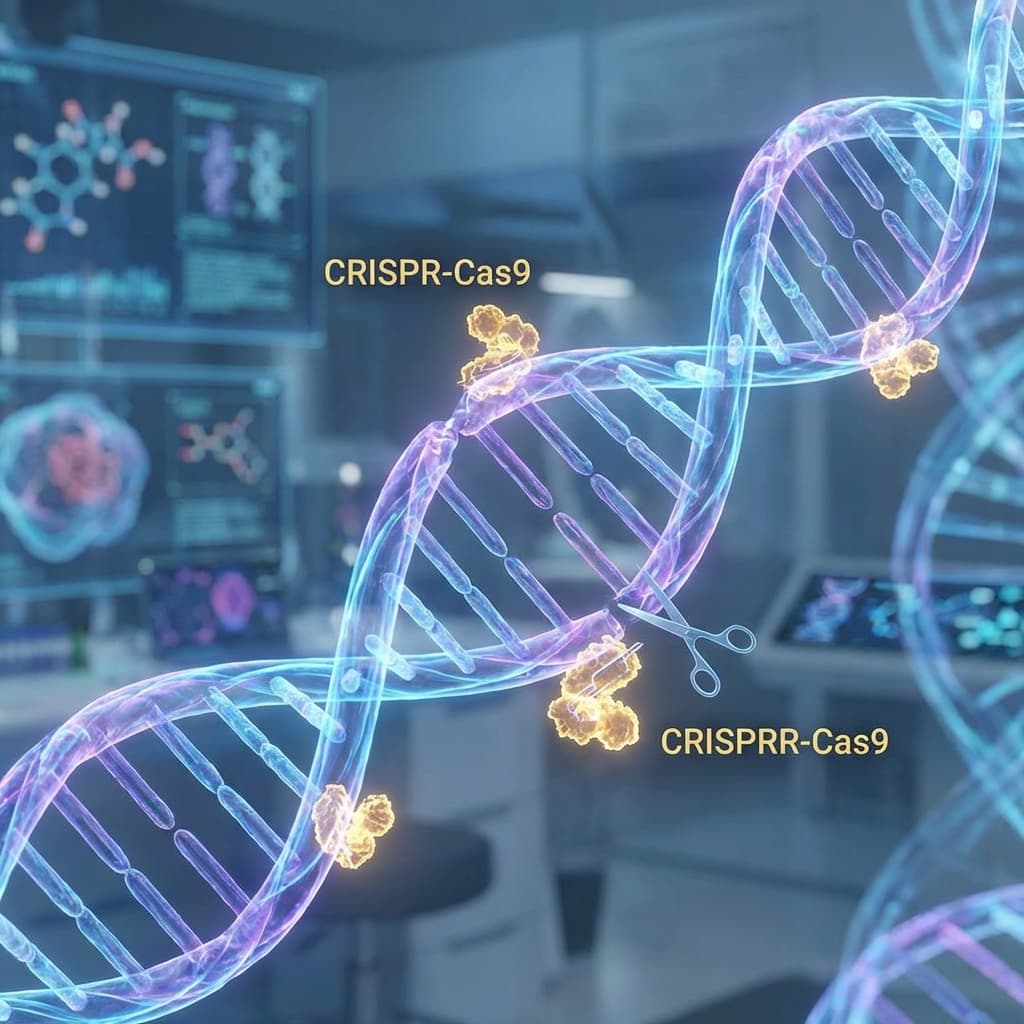
For 4 billion years, the evolution of life on Earth was governed by two forces: random mutation and natural selection. It was a slow, blind, and stumbling process.
That era is over. With the discovery of **CRISPR-Cas9**, Homo sapiens have taken the wheel. We now possess the ability to edit the DNA of any living organism—plants, bacteria, animals, and humans—with the same ease as correcting a typo in a Word document. It is arguably the most significant biological breakthrough since the discovery of DNA itself. But with great power comes a terrified confusion about how to use it.
What is CRISPR? (The Non-Boring Version)
CRISPR (Clustered Regularly Interspaced Short Palindromic Repeats) wasn't invented by scientists; it was invented by bacteria. For eons, bacteria have been at war with viruses. When a bacterium survives a viral attack, it saves a snippet of the virus's DNA in its own genetic archive (the CRISPR array).
If the virus attacks again, the bacterium recognizes it. It arms a protein called **Cas9** (the scissors) with that saved DNA snippet (the mugshot). Cas9 hunts down the matching DNA in the invading virus and snips it, destroying the threat.
In 2012, scientists Jennifer Doudna and Emmanuelle Charpentier (who won the Nobel Prize for this) realized they could program Cas9 to cut any DNA, not just viruses. You give it a target sequence, it finds it, edits it, or deletes it. Simple, cheap, and precise.
The End of Disease?
The most immediate hope for CRISPR is in medicine. There are over 6,000 known genetic diseases caused by a single mutation in our DNA. Theoretically, CRISPR could fix them all.
- Sickle Cell Anemia: Clinical trials are already successful. Doctors remove a patient's bone marrow, edit the stem cells to produce healthy hemoglobin, and put them back. The patient is cured. Not treated—cured.
- Cancer: Scientists are engineering immune cells (T-cells) to be better hunters, allowing them to recognize and destroy cancer cells they previously ignored.
- Blindness: In 2020, doctors injected CRISPR directly into the eye of a patient with Leber Congenital Amaurosis, restoring vision.
Resurrecting the Past: The Woolly Mammoth
It sounds like Jurassic Park, but it’s happening. Companies like Colossal Biosciences are using CRISPR to edit the DNA of the Asian Elephant (the Mammoth's closest living relative) to give it thick hair, fat layers, and cold tolerance.
Why? Not for a zoo. Reintroducing mega-herbivores to the Arctic tundra could help trample the snow, exposing the ground to cold air and preventing the permafrost from melting—a radical form of geoengineering to fight climate change.
The Food Revolution
Forget GMOs (Genetically Modified Organisms) which often involve splicing foreign DNA (like fish genes in tomatoes). CRISPR creates "Gene Edited" crops—simply tweaking the plant's own existing genes.
We are creating wheat that is immune to mildew, rice that produces more grain, and cacao trees that can survive a hotter planet. In a world facing climate crisis and population growth, CRISPR could be the difference between famine and feast.
The Forbidden Door: Designer Babies
Here is where the music stops. If we can fix Sickle Cell, can we also fix... shortness? Or bad eyesight? Or average intelligence?
In 2018, Chinese scientist He Jiankui shocked the world by announcing the birth of twin girls, Lulu and Nana, whose DNA he had edited to be resistant to HIV. It was a massive ethical violation. The scientific community recoiled.
The fear is "Germline Editing"—changes made to embryos that are passed down to future generations. If we start editing our children, we risk splitting humanity into two species: the calculated "GenRich" who are tall, smart, and disease-free, and the "Naturals" who are left behind.
The Risk of "Off-Target" Effects
CRISPR is precise, but not perfect. Sometimes it cuts the wrong place. In a lab dish, that doesn't matter. In a human embryo, an off-target cut could accidentally turn off a tumor-suppressor gene, causing cancer instead of curing it. We are not yet ready to edit the human germline safely.
Conclusion
CRISPR acts as a mirror. It reflects our deepest hopes (a world without pain) and our darkest fears (eugenics and inequality). The technology is here; it cannot be un-invented. The challenge of the 21st century will not be scientific; it will be ethical. We have the pen of the gods in our hands. Now we must learn how to write a story that doesn't end in tragedy.
Conversations (0)
Join Our Newsletter
Be the first to know about new articles and discoveries.
Share this article
You might also like

Intermittent Fasting (IF): Scientific Benefits and Implementation Guide
What is Intermittent Fasting (IF), practiced not just for weight loss but for cellular regeneration and brain health? How is the 16:8 method applied? What does science say?
The James Webb Telescope: Unlocking the Secrets of the Cosmic Dawn
Hubble showed us the universe. Webb is showing us its origin. From analyzing alien atmospheres to spotting the first galaxies, discover how JWST is rewriting astronomy books.
Project Mars: The Blueprint for Humanity's Second Home
It's cold, toxic, and radioactive. So why are we so desperate to go? The scientific roadmap to colonizing the Red Planet.