Space Tourism: The Ultimate Guide to the Final Frontier Vacation
For sixty years, space travel was the exclusive domain of governments. To leave Earth, you had to be a test pilot with nerves of steel and a PhD in astrophysics. You had to be "The Right Stuff."
That era is dead.
We are witnessing the democratization of the cosmos. Driven by the egos and bank accounts of Elon Musk (SpaceX), Jeff Bezos (Blue Origin), and Richard Branson (Virgin Galactic), the door to the stars has been kicked open. It is still a door only the wealthy can afford to walk through, but for the first time in history, the ticket is for sale.
The Menu: What Can You Buy?
Space tourism isn't one thing; it's a tiered menu of experiences, ranging from "expensive" to "GDP of a small nation."
1. The Suborbital Hop (blue Origin & Virgin Galactic)
This is the entry-level package.
Price: ~$450,000
Duration: 10-15 minutes (with 3-4 minutes of weightlessness).
The Experience: You blast off (vertically with Blue, horizontally with Virgin), puncture the Kármán line (100km up), unbuckle, float around the cabin, see the curvature of the Earth against the black void, and then fall back down. It’s the world's most expensive roller coaster, but carrying the title of "Astronaut" is forever.
2. The Orbital Vacation (SpaceX)
This is the real deal. You aren't just popping up and down; you are circling the Earth at 17,500 mph.
Price: ~$50 Million.
Duration: Days to Weeks.
The Experience: The Inspiration4 mission in 2021 proved civilians could handle this. You live, eat, sleep, and use the bathroom (which is complicated) in orbit. You see 16 sunrises and sunsets every single day.
The Space Hotels Are Coming
You can't just float around in a capsule forever. You need a destination.
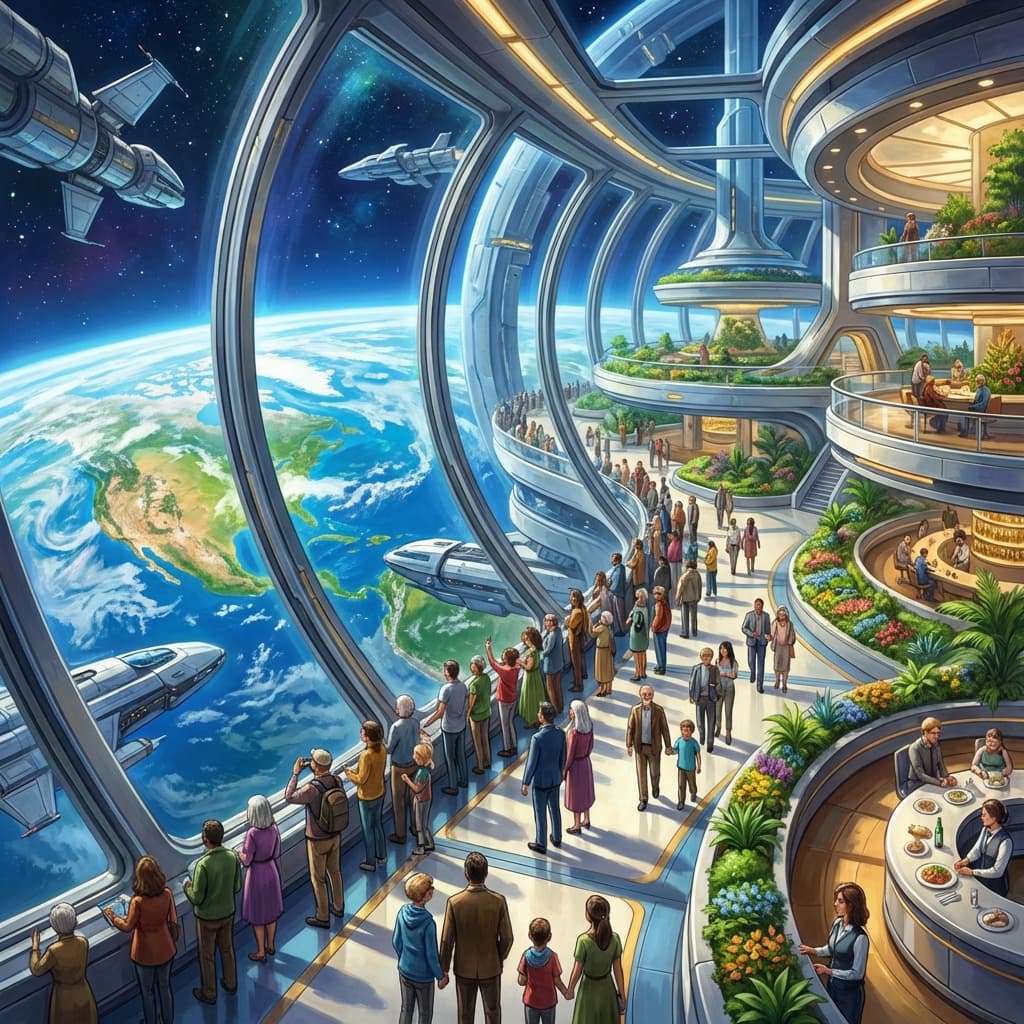
Voyager Station: Slated to open later this decade, this is a rotating space station designed to create artificial gravity (about 1/6th of Earth's). This means you can walk around, sleep in a bed, and drink a cocktail without it floating out of the glass. It envisions luxury villas, gyms, and restaurants—a Hilton in the heavens.
Orbital Reef: A business park in space being built by Blue Origin. Think of it as a "mixed-use" development where scientists can run experiments next door to a tourist shooting a music video.
The Overview Effect
Why do this? Is it just an ego trip for the rich?
Almost every astronaut returns with a cognitive shift known as the **Overview Effect**. Seeing Earth from space—a fragile, blue marble hanging in infinite darkness, with no borders visible—triggers a profound sense of stewardship. They realize how thin our atmosphere is and how silly our terrestrial conflicts are.
Proponents argue that sending more people to space (especially leaders and influencers) could fundamentally change how we treat our planet. As William Shatner said through tears after his Blue Origin flight: "What you have given me is the most profound experience... I hope I never recover from this."
The Environmental Elephant in the Room
You cannot talk about rockets without talking about carbon. Launching a rocket burns a massive amount of fuel. A single suborbital launch can emit as much carbon per passenger as a trans-Atlantic flight, but in just a few minutes.
However, the fuel matters.
Dirty: Virgin Galactic burns solid rubber and nitrous oxide (laughing gas), which is damaging to the ozone layer.
Clean: Blue Origin's New Shepard burns Liquid Hydrogen and Liquid Oxygen. The exhaust? Pure water vapor.
As the industry scales, "Green Propellants" will be a requirement, not an option.
The Future: A Multi-Planetary Species?
Tourism is just the funding mechanism. The real goal, primarily driven by Musk, is Mars.
Every tourist ticket sold helps fund the R&D for the massive Starship vehicle—the rocket designed to carry 100 people to Mars. We are in the "barnstorming" era of aviation, where rich daredevils paid to ride in biplanes. Those joyrides eventually led to the Boeing 747 and global travel.
Today, space is for billionaires. Tomorrow, it might be for millionaires. And one day, your grandchildren might study abroad on the Moon. We are watching the first baby steps of humanity leaving the cradle.
Conversations (0)
Join Our Newsletter
Be the first to know about new articles and discoveries.
Share this article
You might also like
The James Webb Telescope: Unlocking the Secrets of the Cosmic Dawn
Hubble showed us the universe. Webb is showing us its origin. From analyzing alien atmospheres to spotting the first galaxies, discover how JWST is rewriting astronomy books.

The Fermi Paradox: The Most Terrifying Silence in the Universe
With 100 billion stars in our galaxy, we should have been visited by now. So, where is everybody? The answers might keep you up at night.

What is Artificial Intelligence (AI)? The Comprehensive 2026 Guide
Artificial Intelligence is changing the world. But what exactly is it, how does it work, and how will it shape our future? Here is the most comprehensive guide from beginner to advanced.