Classrooms Without Walls: How VR is Revolutionizing Education
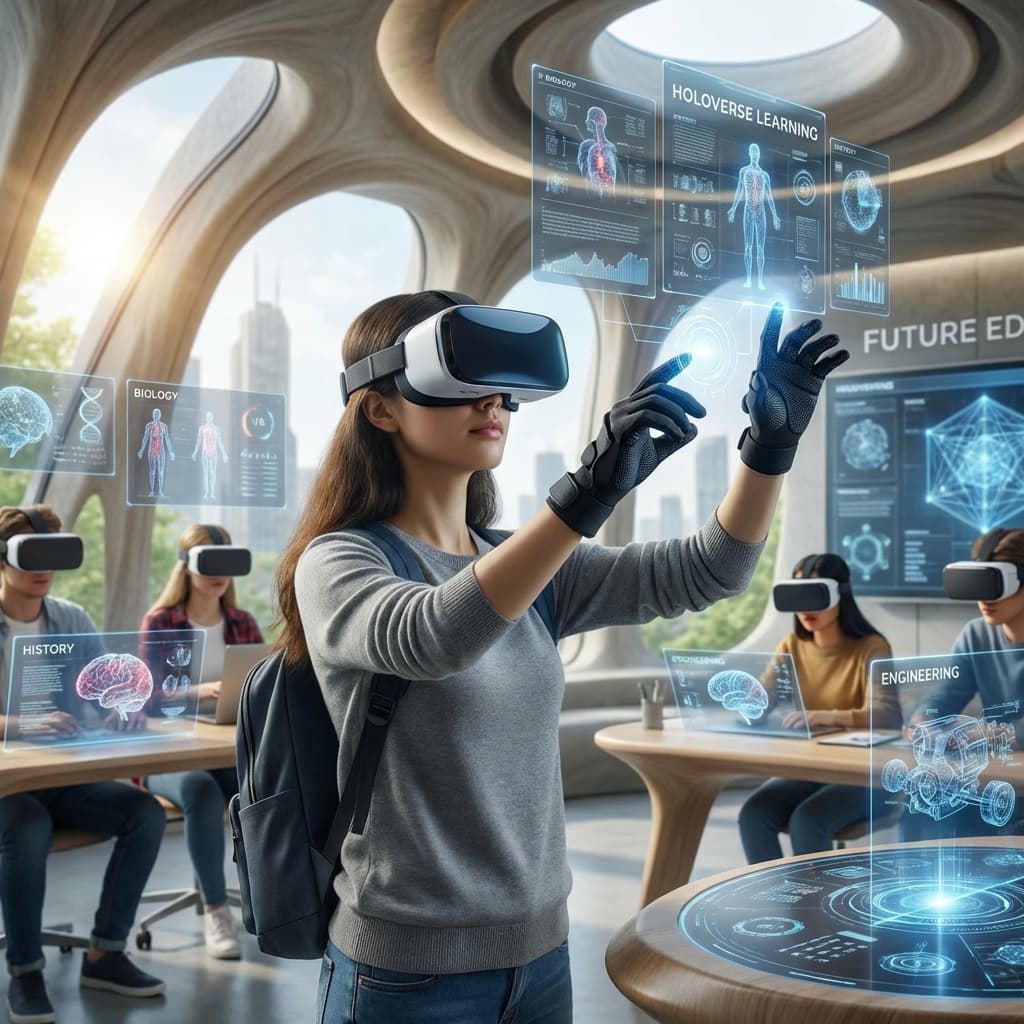
Imagine you are a history teacher. You want to teach your students about the Roman Colosseum.
Option A: You ask them to open page 42 of the textbook and look at a grainy photo.
Option B: You hand them a headset. Suddenly, the walls of the classroom dissolve. They are standing on the sand of the arena in 80 AD. The crowd is roaring (audio spatialization). A Gladiator walks past them.
Which student is going to remember the lesson?
**Virtual Reality (VR)** is not just for gaming. It is the holy grail of education: **Experiential Learning**.
The Retention Problem
The "Cone of Learning" suggests that we remember:
• 10% of what we read.
• 20% of what we hear.
• **90% of what we do**.
VR hacks this system. Because the brain perceives the VR simulation as a spatial reality, it stores the memory as an *experience*, not just information. It triggers the hippocampus (spatial memory).
Impossible Field Trips
Budget cuts have killed the field trip. VR brings it back, on steroids.
Science: Students can shrink down to the size of a blood cell and float through the human artery, watching red blood cells carry oxygen.
Geography: They can stand on the edge of a volcano in Iceland or dive into the Great Barrier Reef to count fish.
Space: They can walk on the surface of Mars, looking back at the pale blue dot of Earth.
Safe Failure: Medical & Technical Training
For medical students, practicing surgery is high-stakes. You can't make mistakes on a live patient. Cadavers are expensive and static.
VR allows "haptic" surgery. A student can perform a heart transplant 100 times in VR. They can feel the resistance of the tissue (force feedback). They can mess up, kill the virtual patient, reset, and try again.
Walmart uses VR to train employees for Black Friday crowds. Pilots have used flight simulators for decades. Now, that level of training is available to everyone.
The Empathy Machine
Chris Milk famously called VR an "Empathy Machine."
You can read about the refugee crisis. But putting on a headset and sitting in a tent in a Syrian refugee camp, making eye contact with a child, changes you. It breaks down the "us vs. them" barrier.
Schools are using VR to fight bullying. You can experience a scenario from the victim's perspective. It builds emotional intelligence (EQ) faster than any lecture.
The Obstacles
If VR is so great, why isn't it in every school?
Cost: Headsets like the Meta Quest 3 are affordable, but buying 30 of them for a class is still $15,000.
Content: We need more high-quality educational software, not just "tech demos."
Motion Sickness: Some students get nauseous.
Conclusion
The classroom of 1920 looks almost identical to the classroom of 2020. Rows of desks. A board at the front.
VR breaks this industrial model. It turns students from passive consumers of information into active explorers. It brings the wonder back to learning. And in a world of distraction, wonder is the only thing that keeps us watching.
Conversations (0)
Join Our Newsletter
Be the first to know about new articles and discoveries.
Share this article
You might also like

Quantum Computing: The End of Reality as We Know It
It's not just a faster computer. It's a machine that defies the laws of physics. Understanding Qubits, Superposition, and the new era of technology.

Neuralink and the Borg: Are We Ready to Merge with AI?
Elon Musk wants to put a chip in your brain. Is it the cure for paralysis, or the end of human privacy? The brave new world of BCIs.

Green Silicon: The Rise of Biophilic Technology
We evolved in forests, not offices. Why the future of technology is 'Green Silicon'—gadgets that breathe, grow, and heal.