The Norwegian Fjords: A Journey Through Nature's Cathedral
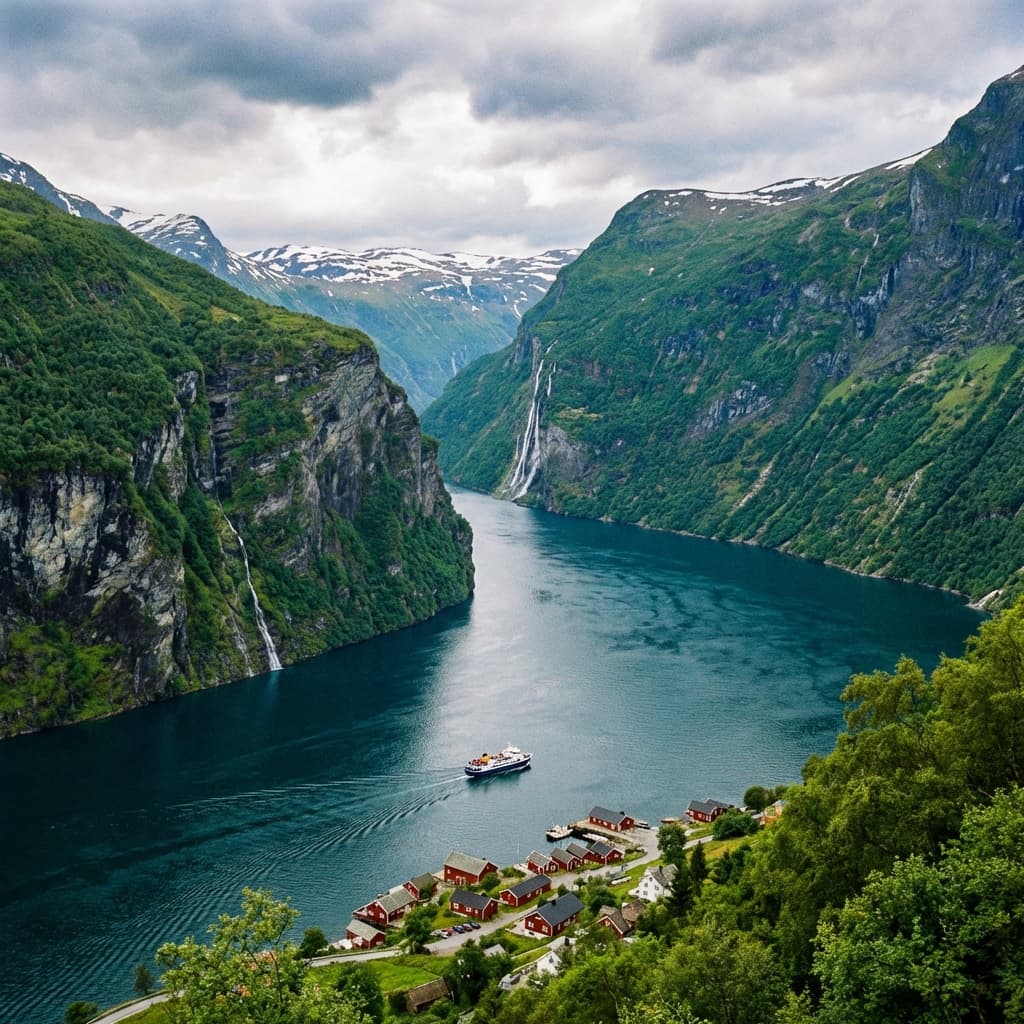
There are places on Earth that are beautiful, and then there are places that make you feel something deeper. A sense of awe. A sense of insignificance. The Norwegian Fjords are the latter.
Carved by massive tongues of ice over millions of years, these deep gashes in the earth are where the mountains meet the sea in a dramatic, silent collision. It is a landscape of vertical extremes—1,000-meter cliffs plunging straight into ink-blue water.
If you are tired of the noise of the modern world, this is where you go to find silence.
What Exactly is a Fjord?
A fjord (pronounced 'fyord') is formed when a giant glacier retreats, cutting a U-shaped valley below sea level. The ocean then fills the valley floor.
This geological violence has created a paradise. Because the water is so deep, the surface is often as calm as a mirror, reflecting the snow-capped peaks above.
The King of Fjords: Sognefjord
They call it the "King of Fjords." It is the longest and deepest in Norway, stretching 205 kilometers inland.
At its deepest point, it is 1,300 meters down—a sunken mountain range. The most famous arm of this fjord is the **Nærøyfjord**. It is so narrow (only 250 meters wide at points) that passing ships are dwarfed by the towering walls on either side. It is a UNESCO World Heritage site, and for good reason. The silence here is physical.
Geirangerfjord: The Fairytale
If Sognefjord is the King, Geirangerfjord is the Queen. It is lush, green, and adorned with jewelry—specifically, waterfalls.
The most famous fall is **The Seven Sisters (De Syv Søstre)**—seven separate streams cascading down the cliff face. Directly opposite them is a single waterfall called **The Suitor**, eternally trying to woo them.
Pro Tip: Don't just take the cruise. Drive up to the **Dalsnibba Skywalk**. At 1,500 meters above sea level, you look down *on top* of the fjord. It feels like standing on the roof of the world.
Trolltunga: The Ultimate Selfie
You have seen the photo. A person standing on a thin tongue of rock, suspended 700 meters above a blue lake.
This is **Trolltunga** (The Troll's Tongue).
The Reality Check: This is not a walk in the park. It is a grueling 28km round-trip hike that takes 10-12 hours. The weather changes instantly. But when you step out onto the rock (crawling, if you are afraid of heights), the adrenaline and the view are a religious experience. You are sitting on the edge of the void.
Pulpit Rock (Preikestolen)
For a slightly easier (but equally terrifying) view, try Preikestolen. It is a massive, flat-topped block of granite rising 604 meters straight out of the Lysefjord.
Tom Cruise dangled off the side of this cliff in *Mission Impossible: Fallout*. We recommend staying safely on the top. It is the perfect place for a picnic, provided the wind isn't blowing too hard.
The Northern Lights (Aurora Borealis)
If you visit in winter (October to March), the fjords offer a second show.
Far from the light pollution of cities, the night sky comes alive. The Aurora Borealis is not just green; it is violet, pink, and white. It dances. It ripples. Watching the lights reflect off the black water of a silent fjord is the kind of memory that makes every dollar of the trip worth it.
The Concept of "Friluftsliv"
To understand the fjords, you must understand the Norwegian word **Friluftsliv**.
Translations like "outdoor life" don't do it justice. It is a philosophy. It is the belief that returning to nature is returning home. It is hiking in the rain and smiling. It is sitting by a fire. It is the understanding that there is no such thing as bad weather, only bad clothing.
Conclusion
A trip to the Norwegian Fjords is not a vacation; it is a reset button. It reminds us that we are small, temporary guests on a violent, beautiful planet. And in that smallness, strangely, there is a great deal of peace.
Test Your Knowledge
Based on this article, you might like these interactive tests.

Conversations (0)
Join Our Newsletter
Be the first to know about new articles and discoveries.
Share this article
You might also like

Patagonia: A Guide to the End of the World
Wind, granite, and ice. Exploring the raw, untamed wilderness of Chile and Argentina. This is not a vacation; it's an adventure.

Iceland's Ring Road: The Ultimate 10-Day Road Trip Guide
Fire, ice, and open roads. A comprehensive mile-by-mile guide to conquering Route 1, hunting aurora, and surviving the Arctic weather.

Santorini: The Post-Apocalyptic Paradise
Behind the Instagram photos lies a violent history. Explore the lost city of Akrotiri, the unique wine, and the raw beauty of the volcano.